Mar 10, 2009
Hacker's Challenge
Hacker's Challenge : Test Your Incident Response Skills Using 20 Scenarios by Mike Schiffman (Conductor)
Publisher: McGraw-Hill Osborne Media (October 1, 2001) | ISBN-10: 0072193840 | PDF | 19,3 Mb | 300 pages
Mike Schiffman has hit upon a great formula for Hacker's Challenge. Rather than try to research, fully understand, and adequately explain attacks that have taken place on other people's networks--the approach taken by too many writers of books about computer security--Schiffman lets network administrators and security experts tell their stories first-hand. This is good. What's better is that Schiffman has edited each of their war stories into two sections: one that presents the observations the sysadmin or security consultant made at the time of the attack, and another (in a separate part of the book) that ties the clues together and explains exactly what was going on. The challenge in the title is for you to figure out what the bad guys were doing--and how best to stop them--before looking at the printed solution. Let's call this book what it is: an book for people with an interest in network security.
It doesn't really matter, from a value-for-money standpoint, whether your skills are up to the challenge or not. The accounts of intrusions--these are no-kidding, real-life attacks that you can probably learn from, by the way--are written like chapters from a novel (though log file listings, network diagrams, and performance graphs appear alongside the narrative text). Recall every time you've seen a movie or read a book with computer scenes so technically inaccurate they made you wish for a writer with a clue. Schiffman and Hacker's Challenge is what you wished for. --David Wall
Link download :
Password default : shytex.com
Hacker's Challenge
Hacker's Challenge : Test Your Incident Response Skills Using 20 Scenarios by Mike Schiffman (Conductor)
Publisher: McGraw-Hill Osborne Media (October 1, 2001) | ISBN-10: 0072193840 | PDF | 19,3 Mb | 300 pages
Mike Schiffman has hit upon a great formula for Hacker's Challenge. Rather than try to research, fully understand, and adequately explain attacks that have taken place on other people's networks--the approach taken by too many writers of books about computer security--Schiffman lets network administrators and security experts tell their stories first-hand. This is good. What's better is that Schiffman has edited each of their war stories into two sections: one that presents the observations the sysadmin or security consultant made at the time of the attack, and another (in a separate part of the book) that ties the clues together and explains exactly what was going on. The challenge in the title is for you to figure out what the bad guys were doing--and how best to stop them--before looking at the printed solution. Let's call this book what it is: an book for people with an interest in network security.
It doesn't really matter, from a value-for-money standpoint, whether your skills are up to the challenge or not. The accounts of intrusions--these are no-kidding, real-life attacks that you can probably learn from, by the way--are written like chapters from a novel (though log file listings, network diagrams, and performance graphs appear alongside the narrative text). Recall every time you've seen a movie or read a book with computer scenes so technically inaccurate they made you wish for a writer with a clue. Schiffman and Hacker's Challenge is what you wished for. --David Wall
Link download :
-
http://rapidshare.com/files/116430857/Hackers.Challenge.pdf
Password default : shytex.com
Hack Attacks Revealed
Take a technogothic journey inside the world of a hacker as seen by security expert John Chirillo. Drawing on his own experience as a hacking consultant for Fortune 1000 companies, Chirillo shows how hackers can exploit network security holes and how you can recognize an oncoming threat to your security. The book features details of the powerful Tiger Box� system, used by hackers to penetrate vulnerable networks, and teaches you how to use that same tool to your advantage.
In this highly provocative work, you�ll discover:
� The hacker�s perspective on networking protocols and communication technologies
� A complete hacker�s technology handbook, illustrating techniques used by hackers, crackers, phreaks, and cyberpunks
� Information discovery and scanning tools for hacking into known and unknown ports and service vulnerabilities
� Detailed instructions for customizing the Tiger Box for your needs and using it to search hack attacks
Link download :
http://rapidshare.de/files/24424276/Hack_Attacks_Revealed.rar
Password default : shytex.com
Securing IM and P2P Applications for the Enterprise (2005)
This book is for system administrators and security professionals who need to bring now ubiquitous IM and P2P applications under their control. Many businesses are now taking advantage of the speed and efficiency offered by both IM and P2P applications, yet are completely ill-equipped to deal with the management and security ramifications.
These companies are now finding out the hard way that these applications which have infiltrated their networks are now the prime targets for malicious network traffic. This book will provide specific information for IT professionals to protect themselves from these vulnerabilities at both the network and application layers by identifying and blocking this malicious traffic.
* A recent study by the Yankee group ranked "managing and securing IM and P2P applications" as the #3 priority for IT managers in 2004
* The recently updated SANS/FBI top 10 list of vulnerabilities for computers running Microsoft Windows contained both P2P and IM applications for the first time
* The recently released Symantec Threat Assessment report for the first half of 2004 showed that 19 of the top 50 virus threats targeted IM or P2P applications. Despite the prevalence of IM and P2P applications on corporate networks and the risks they pose, there are no other books covering these topics
URL
http://www.amazon.com/Securing-Im-P2P-Applications-Enterprise/dp/1597490172
Download
Code:
Password default : shytex.com
Malicious Cryptography: Exposing Cryptovirology (Paperback)
Book Description
Hackers have uncovered the dark side of cryptography�that device developed to defeat Trojan horses, viruses, password theft, and other cyber-crime. It�s called cryptovirology, the art of turning the very methods designed to protect your data into a means of subverting it. In this fascinating, disturbing volume, the experts who first identified cryptovirology show you exactly what you�re up against and how to fight back.
They will take you inside the brilliant and devious mind of a hacker�as much an addict as the vacant-eyed denizen of the crackhouse�so you can feel the rush and recognize your opponent�s power. Then, they will arm you for the counterattack.
This book reads like a futuristic fantasy, but be assured, the threat is ominously real. Vigilance is essential, now.
* Understand the mechanics of computationally secure information stealing
* Learn how non-zero sum Game Theory is used to develop survivable malware
* Discover how hackers use public key cryptography to mount extortion attacks
* Recognize and combat the danger of kleptographic attacks on smart-card devices
* Build a strong arsenal against a cryptovirology attack
Code:
Password default : shytex.com
Practical Hacking Techniques and Countermeasures (Hardcover)
Book Description
Practical Hacking Techniques and Countermeasures examines computer security from the hacker's perspective, demonstrating how a computer system can be successfully attacked and compromised. This book shows how an attack is conceptualized, formulated and performed. With the VMware� Workstation software package available on the accompanying CD, it uses virtual computers to illustrate how an attack is executed, including the script, compilation, and results. It offers examples of attacks on Windows and Linux. It also covers such topics as footprinting, scanning, sniffing, passwords, and other attack tools. This text provides valuable information for constructing a system to defend against attacks.
Code:
Password default : shytex.com
Ajax Security: The Hands-On, Practical Guide to Preventing, Ajax-Related Security Vulnerabilities (Paperback)
The Hands-On, Practical Guide to Preventing Ajax-Related Security
Vulnerabilities
More and more Web sites are being rewritten as Ajax applications; even
traditional desktop software is rapidly moving to the Web via Ajax. But,
all too often, this transition is being made with reckless disregard for
security. If Ajax applications aren't designed and coded properly, they
can be susceptible to far more dangerous security vulnerabilities than
conventional Web or desktop software. Ajax developers desperately need
guidance on securing their applications: knowledge that's been virtually
impossible to find, until now.
Ajax Security systematically debunks today's most dangerous
myths about Ajax security, illustrating key points with detailed case
studies of actual exploited Ajax vulnerabilities, ranging from MySpace's
Samy worm to MacWorld's conference code validator. Even more important,
it delivers specific, up-to-the-minute recommendations for securing Ajax
applications in each major Web programming language and environment,
including .NET, Java, PHP, and even Ruby on Rails. You'll learn how to:
* Mitigate unique risks associated with Ajax, including overly
granular Web services, application control flow tampering, and
manipulation of program logic
* Write new Ajax code more safely�and identify and fix flaws in
existing code
* Prevent emerging Ajax-specific attacks, including JavaScript
hijacking and persistent storage theft
* Avoid attacks based on XSS and SQL Injection�including a
dangerous SQL Injection variant that can extract an entire backend
database with just two requests
* Leverage security built into Ajax frameworks like Prototype,
Dojo, and ASP.NET AJAX Extensions�and recognize what you still must
implement on your own
* Create more secure �mashup� applications
Ajax Security will be an indispensable resource for developers coding or
maintaining Ajax applications; architects and development managers
planning or designing new Ajax software, and all software security
professionals, from QA specialists to penetration testers.
URL:
Code:
http://www.amazon.com/exec/obidos/tg/detail/-/0321491939/
Download:
Code:
http://rapidshare.com/files/99941971/Addison.Wesley.Ajax.Security.Dec.2007.pdf
Password default : shytex.com
Exploiting Software: How to Break Code (Paperback)
by Greg Hoglund, Gary McGraw
Paperback: 512 pages
Publisher: Addison-Wesley Professional (February 17, 2004)
Language: English
ISBN: 0201786958
Software security is gaining momentum as security professionals realize that computer security is really all about making software behave. The publication of Building Secure Software in 2001 (Viega and McGraw) unleashed a number of related books that have crystallized software security as a critical field. Already, security professionals, software developers, and business leaders are resonating with the message and asking for more. Building Secure Software (co-authored by McGraw) is intended for software professionals ranging from developers to managers, and is aimed at helping people develop more secure code. Exploiting Software is useful to the same target audience, but is really intended for security professionals interested in how to find new flaws in software. This book should be of particular interest to security practitioners working to beef up their software security skills, including red teams and ethical hackers. Exploiting Software is about how to break code. Our intention is to provide a realistic view of the technical issues faced by security professionals. This book is aimed directly toward software security as opposed to network security. As security professionals come to grips with the software security problem, they need to understand how software systems break. Solutions to each of the problems discussed in Exploiting Software can be found in Building Secure Software. The two books are mirror images of each other. We believe that software security and application security practitioners are in for a reality check. The problem is that simple and popular approaches being hawked by upstart "application security" vendors as solutions--such as canned black box testing tools--barely scratch the surface. This book aims to cut directly through the hype to the heart of the matter. We need to get real about what we're up against. This book describes exactly that. What This Book Is About This book closely examines many real-world software exploits, explaining how and why they work, the attack patterns they are based on, and in some cases how they were discovered. Along the way, this book also shows how to uncover new software vulnerabilities and how to use them to break machines. Chapter 1 describes why software is the root of the computer security problem. We introduce the trinity of trouble--complexity, extensibility, and connectivity--and describe why the software security problem is growing. We also describe the future of software and its implications for software exploit. Chapter 2 describes the difference between implementation bugs and architectural flaws. We discuss the problem of securing an open system, and explain why risk management is the only sane approach. Two real-world exploits are introduced: one very simple and one technically complex. At the heart of Chapter 2 is a description of attack patterns. We show how attack patterns fit into the classic network security paradigm and describe the role that attack patterns play in the rest of the book. The subject of Chapter 3 is reverse engineering. Attackers disassemble, decompile, and deconstruct programs to understand how they work and how they can be made not to. Chapter 3 describes common gray box analysis techniques, including the idea of using a security patch as an attack map. We discuss Interactive Disassembler (IDA), the state-of-the-art tool used by hackers to understand programs. We also discuss in detail how real cracking tools are built and used. In Chapters 4, 5, 6, and 7, we discuss particular attack examples that provide instances of attack patterns. These examples are marked with an asterisk. Chapters 4 and 5 cover the two ends of the client-server model. Chapter 4 begins where the book Hacking Exposed McClure et al., 1999 leaves off, discussing trusted input, privilege escalation, injection, path tracing, exploiting trust, and other attack techniques specific to server software. Chapter 5 is about attacking client software using in-band signals, cross-site scripting, and mobile code. The problem of backwash attacks is also introduced. Both chapters are studded with attack patterns and examples of real attacks. Chapter 6 is about crafting malicious input. It goes far beyond standard-issue "fuzzing" to discuss partition analysis, tracing code, and reversing parser code. Special attention is paid to crafting equivalent requests using alternate encoding techniques. Once again, both real-world example exploits and the attack patterns that inspire them are highlighted throughout. The whipping boy of software security, the dreaded buffer overflow, is the subject of Chapter 7. This chapter is a highly technical treatment of buffer overflow attacks that leverages the fact that other texts supply the basics. We discuss buffer overflows in embedded systems, database buffer overflows, buffer overflow as targeted against Java, and content-based buffer overflows. Chapter 7 also describes how to find potential buffer overflows of all kinds, including stack overflows, arithmetic errors, format string vulnerabilities, heap overflows, C++ vtables, and multistage trampolines. Payload architecture is covered in detail for a number of platforms, including x86, MIPS, SPARC, and PA-RISC. Advanced techniques such as active armor and the use of trampolines to defeat weak security mechanisms are also covered. Chapter 7 includes a large number of attack patterns. Chapter 8 is about rootkits--the ultimate apex of software exploit. This is what it means for a machine to be "owned." Chapter 8 centers around code for a real Windows XP rootkit. We cover call hooking, executable redirection, hiding files and processes, network support, and patching binary code. Hardware issues are also discussed in detail, including techniques used in the wild to hide rootkits in EEPROM. A number of advanced rootkit topics top off Chapter 8. As you can see, Exploiting Software runs the gamut of software risk, from malicious input to stealthy rootkits. Using attack patterns, real code, and example exploits, we clearly demonstrate the techniques that are used every day by real malicious hackers against software. How to Use This Book This book is useful to many different kinds of people: network administrators, security consultants, information warriors, developers, and security programmers. If you are responsible for a network full of running software, you should read this book to learn the kinds of weaknesses that exist in your system and how they are likely to manifest. If you are a security consultant, you should read this book so you can effectively locate, understand, and measure security holes in customer systems. If you are involved in offensive information warfare, you should use this book to learn how to penetrate enemy systems through software. If you create software for a living, you should read this book to understand how attackers will approach your creation. Today, all developers should be security minded. The knowledge here will arm you with a real understanding of the software security problem. If you are a security programmer who knows your way around code, you will love this book. The primary audience for this book is the security programmer, but there are important lessons here for all computer professionals. But Isn't This Too Dangerous? It's important to emphasize that none of the information we discuss here is news to the hacker community. Some of these techniques are as old as the hills. Our real objective is to provide some eye-opening information and up the level of discourse in software security. Some security experts may worry that revealing the techniques described in this book will encourage more people to try them out. Perhaps this is true, but hackers have always had better lines of communication and information sharing than the good guys. This information needs to be understood and digested by security professionals so that they know the magnitude of the problem and they can begin to address it properly. Shall we grab the bull by the horns or put our head in the sand? Perhaps this book will shock you. No matter what, it will educate you.
CODE
http://rapidshare.com/files/172502937/0201786958_Addison.Wesley_-_Exploiting.Software.How.to.Break.Code.Feb.2004.rar
Password default : shytex.com
by Greg Hoglund, Gary McGraw
Paperback: 512 pages
Publisher: Addison-Wesley Professional (February 17, 2004)
Language: English
ISBN: 0201786958
Software security is gaining momentum as security professionals realize that computer security is really all about making software behave. The publication of Building Secure Software in 2001 (Viega and McGraw) unleashed a number of related books that have crystallized software security as a critical field. Already, security professionals, software developers, and business leaders are resonating with the message and asking for more. Building Secure Software (co-authored by McGraw) is intended for software professionals ranging from developers to managers, and is aimed at helping people develop more secure code. Exploiting Software is useful to the same target audience, but is really intended for security professionals interested in how to find new flaws in software. This book should be of particular interest to security practitioners working to beef up their software security skills, including red teams and ethical hackers. Exploiting Software is about how to break code. Our intention is to provide a realistic view of the technical issues faced by security professionals. This book is aimed directly toward software security as opposed to network security. As security professionals come to grips with the software security problem, they need to understand how software systems break. Solutions to each of the problems discussed in Exploiting Software can be found in Building Secure Software. The two books are mirror images of each other. We believe that software security and application security practitioners are in for a reality check. The problem is that simple and popular approaches being hawked by upstart "application security" vendors as solutions--such as canned black box testing tools--barely scratch the surface. This book aims to cut directly through the hype to the heart of the matter. We need to get real about what we're up against. This book describes exactly that. What This Book Is About This book closely examines many real-world software exploits, explaining how and why they work, the attack patterns they are based on, and in some cases how they were discovered. Along the way, this book also shows how to uncover new software vulnerabilities and how to use them to break machines. Chapter 1 describes why software is the root of the computer security problem. We introduce the trinity of trouble--complexity, extensibility, and connectivity--and describe why the software security problem is growing. We also describe the future of software and its implications for software exploit. Chapter 2 describes the difference between implementation bugs and architectural flaws. We discuss the problem of securing an open system, and explain why risk management is the only sane approach. Two real-world exploits are introduced: one very simple and one technically complex. At the heart of Chapter 2 is a description of attack patterns. We show how attack patterns fit into the classic network security paradigm and describe the role that attack patterns play in the rest of the book. The subject of Chapter 3 is reverse engineering. Attackers disassemble, decompile, and deconstruct programs to understand how they work and how they can be made not to. Chapter 3 describes common gray box analysis techniques, including the idea of using a security patch as an attack map. We discuss Interactive Disassembler (IDA), the state-of-the-art tool used by hackers to understand programs. We also discuss in detail how real cracking tools are built and used. In Chapters 4, 5, 6, and 7, we discuss particular attack examples that provide instances of attack patterns. These examples are marked with an asterisk. Chapters 4 and 5 cover the two ends of the client-server model. Chapter 4 begins where the book Hacking Exposed McClure et al., 1999 leaves off, discussing trusted input, privilege escalation, injection, path tracing, exploiting trust, and other attack techniques specific to server software. Chapter 5 is about attacking client software using in-band signals, cross-site scripting, and mobile code. The problem of backwash attacks is also introduced. Both chapters are studded with attack patterns and examples of real attacks. Chapter 6 is about crafting malicious input. It goes far beyond standard-issue "fuzzing" to discuss partition analysis, tracing code, and reversing parser code. Special attention is paid to crafting equivalent requests using alternate encoding techniques. Once again, both real-world example exploits and the attack patterns that inspire them are highlighted throughout. The whipping boy of software security, the dreaded buffer overflow, is the subject of Chapter 7. This chapter is a highly technical treatment of buffer overflow attacks that leverages the fact that other texts supply the basics. We discuss buffer overflows in embedded systems, database buffer overflows, buffer overflow as targeted against Java, and content-based buffer overflows. Chapter 7 also describes how to find potential buffer overflows of all kinds, including stack overflows, arithmetic errors, format string vulnerabilities, heap overflows, C++ vtables, and multistage trampolines. Payload architecture is covered in detail for a number of platforms, including x86, MIPS, SPARC, and PA-RISC. Advanced techniques such as active armor and the use of trampolines to defeat weak security mechanisms are also covered. Chapter 7 includes a large number of attack patterns. Chapter 8 is about rootkits--the ultimate apex of software exploit. This is what it means for a machine to be "owned." Chapter 8 centers around code for a real Windows XP rootkit. We cover call hooking, executable redirection, hiding files and processes, network support, and patching binary code. Hardware issues are also discussed in detail, including techniques used in the wild to hide rootkits in EEPROM. A number of advanced rootkit topics top off Chapter 8. As you can see, Exploiting Software runs the gamut of software risk, from malicious input to stealthy rootkits. Using attack patterns, real code, and example exploits, we clearly demonstrate the techniques that are used every day by real malicious hackers against software. How to Use This Book This book is useful to many different kinds of people: network administrators, security consultants, information warriors, developers, and security programmers. If you are responsible for a network full of running software, you should read this book to learn the kinds of weaknesses that exist in your system and how they are likely to manifest. If you are a security consultant, you should read this book so you can effectively locate, understand, and measure security holes in customer systems. If you are involved in offensive information warfare, you should use this book to learn how to penetrate enemy systems through software. If you create software for a living, you should read this book to understand how attackers will approach your creation. Today, all developers should be security minded. The knowledge here will arm you with a real understanding of the software security problem. If you are a security programmer who knows your way around code, you will love this book. The primary audience for this book is the security programmer, but there are important lessons here for all computer professionals. But Isn't This Too Dangerous? It's important to emphasize that none of the information we discuss here is news to the hacker community. Some of these techniques are as old as the hills. Our real objective is to provide some eye-opening information and up the level of discourse in software security. Some security experts may worry that revealing the techniques described in this book will encourage more people to try them out. Perhaps this is true, but hackers have always had better lines of communication and information sharing than the good guys. This information needs to be understood and digested by security professionals so that they know the magnitude of the problem and they can begin to address it properly. Shall we grab the bull by the horns or put our head in the sand? Perhaps this book will shock you. No matter what, it will educate you.
CODE
http://rapidshare.com/files/172502937/0201786958_Addison.Wesley_-_Exploiting.Software.How.to.Break.Code.Feb.2004.rar
Password default : shytex.com
Hack Attacks Revealed
Take a technogothic journey inside the world of a hacker as seen by security expert John Chirillo. Drawing on his own experience as a hacking consultant for Fortune 1000 companies, Chirillo shows how hackers can exploit network security holes and how you can recognize an oncoming threat to your security. The book features details of the powerful Tiger Box� system, used by hackers to penetrate vulnerable networks, and teaches you how to use that same tool to your advantage.
In this highly provocative work, you�ll discover:
� The hacker�s perspective on networking protocols and communication technologies
� A complete hacker�s technology handbook, illustrating techniques used by hackers, crackers, phreaks, and cyberpunks
� Information discovery and scanning tools for hacking into known and unknown ports and service vulnerabilities
� Detailed instructions for customizing the Tiger Box for your needs and using it to search hack attacks
Link download :
http://rapidshare.de/files/24424276/Hack_Attacks_Revealed.rar
Password default : shytex.com
Malicious Cryptography: Exposing Cryptovirology (Paperback)
Book Description
Hackers have uncovered the dark side of cryptography�that device developed to defeat Trojan horses, viruses, password theft, and other cyber-crime. It�s called cryptovirology, the art of turning the very methods designed to protect your data into a means of subverting it. In this fascinating, disturbing volume, the experts who first identified cryptovirology show you exactly what you�re up against and how to fight back.
They will take you inside the brilliant and devious mind of a hacker�as much an addict as the vacant-eyed denizen of the crackhouse�so you can feel the rush and recognize your opponent�s power. Then, they will arm you for the counterattack.
This book reads like a futuristic fantasy, but be assured, the threat is ominously real. Vigilance is essential, now.
* Understand the mechanics of computationally secure information stealing
* Learn how non-zero sum Game Theory is used to develop survivable malware
* Discover how hackers use public key cryptography to mount extortion attacks
* Recognize and combat the danger of kleptographic attacks on smart-card devices
* Build a strong arsenal against a cryptovirology attack
Code:
Password default : shytex.com
Practical Hacking Techniques and Countermeasures (Hardcover)
Book Description
Practical Hacking Techniques and Countermeasures examines computer security from the hacker's perspective, demonstrating how a computer system can be successfully attacked and compromised. This book shows how an attack is conceptualized, formulated and performed. With the VMware� Workstation software package available on the accompanying CD, it uses virtual computers to illustrate how an attack is executed, including the script, compilation, and results. It offers examples of attacks on Windows and Linux. It also covers such topics as footprinting, scanning, sniffing, passwords, and other attack tools. This text provides valuable information for constructing a system to defend against attacks.
Code:
Password default : shytex.com
Ajax Security: The Hands-On, Practical Guide to Preventing, Ajax-Related Security Vulnerabilities (Paperback)
The Hands-On, Practical Guide to Preventing Ajax-Related Security
Vulnerabilities
More and more Web sites are being rewritten as Ajax applications; even
traditional desktop software is rapidly moving to the Web via Ajax. But,
all too often, this transition is being made with reckless disregard for
security. If Ajax applications aren't designed and coded properly, they
can be susceptible to far more dangerous security vulnerabilities than
conventional Web or desktop software. Ajax developers desperately need
guidance on securing their applications: knowledge that's been virtually
impossible to find, until now.
Ajax Security systematically debunks today's most dangerous
myths about Ajax security, illustrating key points with detailed case
studies of actual exploited Ajax vulnerabilities, ranging from MySpace's
Samy worm to MacWorld's conference code validator. Even more important,
it delivers specific, up-to-the-minute recommendations for securing Ajax
applications in each major Web programming language and environment,
including .NET, Java, PHP, and even Ruby on Rails. You'll learn how to:
* Mitigate unique risks associated with Ajax, including overly
granular Web services, application control flow tampering, and
manipulation of program logic
* Write new Ajax code more safely�and identify and fix flaws in
existing code
* Prevent emerging Ajax-specific attacks, including JavaScript
hijacking and persistent storage theft
* Avoid attacks based on XSS and SQL Injection�including a
dangerous SQL Injection variant that can extract an entire backend
database with just two requests
* Leverage security built into Ajax frameworks like Prototype,
Dojo, and ASP.NET AJAX Extensions�and recognize what you still must
implement on your own
* Create more secure �mashup� applications
Ajax Security will be an indispensable resource for developers coding or
maintaining Ajax applications; architects and development managers
planning or designing new Ajax software, and all software security
professionals, from QA specialists to penetration testers.
URL:
Code:
http://www.amazon.com/exec/obidos/tg/detail/-/0321491939/
Download:
Code:
http://rapidshare.com/files/99941971/Addison.Wesley.Ajax.Security.Dec.2007.pdf
Password default : shytex.com
Exploiting Software: How to Break Code (Paperback)
by Greg Hoglund, Gary McGraw
Paperback: 512 pages
Publisher: Addison-Wesley Professional (February 17, 2004)
Language: English
ISBN: 0201786958
Software security is gaining momentum as security professionals realize that computer security is really all about making software behave. The publication of Building Secure Software in 2001 (Viega and McGraw) unleashed a number of related books that have crystallized software security as a critical field. Already, security professionals, software developers, and business leaders are resonating with the message and asking for more. Building Secure Software (co-authored by McGraw) is intended for software professionals ranging from developers to managers, and is aimed at helping people develop more secure code. Exploiting Software is useful to the same target audience, but is really intended for security professionals interested in how to find new flaws in software. This book should be of particular interest to security practitioners working to beef up their software security skills, including red teams and ethical hackers. Exploiting Software is about how to break code. Our intention is to provide a realistic view of the technical issues faced by security professionals. This book is aimed directly toward software security as opposed to network security. As security professionals come to grips with the software security problem, they need to understand how software systems break. Solutions to each of the problems discussed in Exploiting Software can be found in Building Secure Software. The two books are mirror images of each other. We believe that software security and application security practitioners are in for a reality check. The problem is that simple and popular approaches being hawked by upstart "application security" vendors as solutions--such as canned black box testing tools--barely scratch the surface. This book aims to cut directly through the hype to the heart of the matter. We need to get real about what we're up against. This book describes exactly that. What This Book Is About This book closely examines many real-world software exploits, explaining how and why they work, the attack patterns they are based on, and in some cases how they were discovered. Along the way, this book also shows how to uncover new software vulnerabilities and how to use them to break machines. Chapter 1 describes why software is the root of the computer security problem. We introduce the trinity of trouble--complexity, extensibility, and connectivity--and describe why the software security problem is growing. We also describe the future of software and its implications for software exploit. Chapter 2 describes the difference between implementation bugs and architectural flaws. We discuss the problem of securing an open system, and explain why risk management is the only sane approach. Two real-world exploits are introduced: one very simple and one technically complex. At the heart of Chapter 2 is a description of attack patterns. We show how attack patterns fit into the classic network security paradigm and describe the role that attack patterns play in the rest of the book. The subject of Chapter 3 is reverse engineering. Attackers disassemble, decompile, and deconstruct programs to understand how they work and how they can be made not to. Chapter 3 describes common gray box analysis techniques, including the idea of using a security patch as an attack map. We discuss Interactive Disassembler (IDA), the state-of-the-art tool used by hackers to understand programs. We also discuss in detail how real cracking tools are built and used. In Chapters 4, 5, 6, and 7, we discuss particular attack examples that provide instances of attack patterns. These examples are marked with an asterisk. Chapters 4 and 5 cover the two ends of the client-server model. Chapter 4 begins where the book Hacking Exposed McClure et al., 1999 leaves off, discussing trusted input, privilege escalation, injection, path tracing, exploiting trust, and other attack techniques specific to server software. Chapter 5 is about attacking client software using in-band signals, cross-site scripting, and mobile code. The problem of backwash attacks is also introduced. Both chapters are studded with attack patterns and examples of real attacks. Chapter 6 is about crafting malicious input. It goes far beyond standard-issue "fuzzing" to discuss partition analysis, tracing code, and reversing parser code. Special attention is paid to crafting equivalent requests using alternate encoding techniques. Once again, both real-world example exploits and the attack patterns that inspire them are highlighted throughout. The whipping boy of software security, the dreaded buffer overflow, is the subject of Chapter 7. This chapter is a highly technical treatment of buffer overflow attacks that leverages the fact that other texts supply the basics. We discuss buffer overflows in embedded systems, database buffer overflows, buffer overflow as targeted against Java, and content-based buffer overflows. Chapter 7 also describes how to find potential buffer overflows of all kinds, including stack overflows, arithmetic errors, format string vulnerabilities, heap overflows, C++ vtables, and multistage trampolines. Payload architecture is covered in detail for a number of platforms, including x86, MIPS, SPARC, and PA-RISC. Advanced techniques such as active armor and the use of trampolines to defeat weak security mechanisms are also covered. Chapter 7 includes a large number of attack patterns. Chapter 8 is about rootkits--the ultimate apex of software exploit. This is what it means for a machine to be "owned." Chapter 8 centers around code for a real Windows XP rootkit. We cover call hooking, executable redirection, hiding files and processes, network support, and patching binary code. Hardware issues are also discussed in detail, including techniques used in the wild to hide rootkits in EEPROM. A number of advanced rootkit topics top off Chapter 8. As you can see, Exploiting Software runs the gamut of software risk, from malicious input to stealthy rootkits. Using attack patterns, real code, and example exploits, we clearly demonstrate the techniques that are used every day by real malicious hackers against software. How to Use This Book This book is useful to many different kinds of people: network administrators, security consultants, information warriors, developers, and security programmers. If you are responsible for a network full of running software, you should read this book to learn the kinds of weaknesses that exist in your system and how they are likely to manifest. If you are a security consultant, you should read this book so you can effectively locate, understand, and measure security holes in customer systems. If you are involved in offensive information warfare, you should use this book to learn how to penetrate enemy systems through software. If you create software for a living, you should read this book to understand how attackers will approach your creation. Today, all developers should be security minded. The knowledge here will arm you with a real understanding of the software security problem. If you are a security programmer who knows your way around code, you will love this book. The primary audience for this book is the security programmer, but there are important lessons here for all computer professionals. But Isn't This Too Dangerous? It's important to emphasize that none of the information we discuss here is news to the hacker community. Some of these techniques are as old as the hills. Our real objective is to provide some eye-opening information and up the level of discourse in software security. Some security experts may worry that revealing the techniques described in this book will encourage more people to try them out. Perhaps this is true, but hackers have always had better lines of communication and information sharing than the good guys. This information needs to be understood and digested by security professionals so that they know the magnitude of the problem and they can begin to address it properly. Shall we grab the bull by the horns or put our head in the sand? Perhaps this book will shock you. No matter what, it will educate you.
CODE
http://rapidshare.com/files/172502937/0201786958_Addison.Wesley_-_Exploiting.Software.How.to.Break.Code.Feb.2004.rar
Password default : shytex.com
by Greg Hoglund, Gary McGraw
Paperback: 512 pages
Publisher: Addison-Wesley Professional (February 17, 2004)
Language: English
ISBN: 0201786958
Software security is gaining momentum as security professionals realize that computer security is really all about making software behave. The publication of Building Secure Software in 2001 (Viega and McGraw) unleashed a number of related books that have crystallized software security as a critical field. Already, security professionals, software developers, and business leaders are resonating with the message and asking for more. Building Secure Software (co-authored by McGraw) is intended for software professionals ranging from developers to managers, and is aimed at helping people develop more secure code. Exploiting Software is useful to the same target audience, but is really intended for security professionals interested in how to find new flaws in software. This book should be of particular interest to security practitioners working to beef up their software security skills, including red teams and ethical hackers. Exploiting Software is about how to break code. Our intention is to provide a realistic view of the technical issues faced by security professionals. This book is aimed directly toward software security as opposed to network security. As security professionals come to grips with the software security problem, they need to understand how software systems break. Solutions to each of the problems discussed in Exploiting Software can be found in Building Secure Software. The two books are mirror images of each other. We believe that software security and application security practitioners are in for a reality check. The problem is that simple and popular approaches being hawked by upstart "application security" vendors as solutions--such as canned black box testing tools--barely scratch the surface. This book aims to cut directly through the hype to the heart of the matter. We need to get real about what we're up against. This book describes exactly that. What This Book Is About This book closely examines many real-world software exploits, explaining how and why they work, the attack patterns they are based on, and in some cases how they were discovered. Along the way, this book also shows how to uncover new software vulnerabilities and how to use them to break machines. Chapter 1 describes why software is the root of the computer security problem. We introduce the trinity of trouble--complexity, extensibility, and connectivity--and describe why the software security problem is growing. We also describe the future of software and its implications for software exploit. Chapter 2 describes the difference between implementation bugs and architectural flaws. We discuss the problem of securing an open system, and explain why risk management is the only sane approach. Two real-world exploits are introduced: one very simple and one technically complex. At the heart of Chapter 2 is a description of attack patterns. We show how attack patterns fit into the classic network security paradigm and describe the role that attack patterns play in the rest of the book. The subject of Chapter 3 is reverse engineering. Attackers disassemble, decompile, and deconstruct programs to understand how they work and how they can be made not to. Chapter 3 describes common gray box analysis techniques, including the idea of using a security patch as an attack map. We discuss Interactive Disassembler (IDA), the state-of-the-art tool used by hackers to understand programs. We also discuss in detail how real cracking tools are built and used. In Chapters 4, 5, 6, and 7, we discuss particular attack examples that provide instances of attack patterns. These examples are marked with an asterisk. Chapters 4 and 5 cover the two ends of the client-server model. Chapter 4 begins where the book Hacking Exposed McClure et al., 1999 leaves off, discussing trusted input, privilege escalation, injection, path tracing, exploiting trust, and other attack techniques specific to server software. Chapter 5 is about attacking client software using in-band signals, cross-site scripting, and mobile code. The problem of backwash attacks is also introduced. Both chapters are studded with attack patterns and examples of real attacks. Chapter 6 is about crafting malicious input. It goes far beyond standard-issue "fuzzing" to discuss partition analysis, tracing code, and reversing parser code. Special attention is paid to crafting equivalent requests using alternate encoding techniques. Once again, both real-world example exploits and the attack patterns that inspire them are highlighted throughout. The whipping boy of software security, the dreaded buffer overflow, is the subject of Chapter 7. This chapter is a highly technical treatment of buffer overflow attacks that leverages the fact that other texts supply the basics. We discuss buffer overflows in embedded systems, database buffer overflows, buffer overflow as targeted against Java, and content-based buffer overflows. Chapter 7 also describes how to find potential buffer overflows of all kinds, including stack overflows, arithmetic errors, format string vulnerabilities, heap overflows, C++ vtables, and multistage trampolines. Payload architecture is covered in detail for a number of platforms, including x86, MIPS, SPARC, and PA-RISC. Advanced techniques such as active armor and the use of trampolines to defeat weak security mechanisms are also covered. Chapter 7 includes a large number of attack patterns. Chapter 8 is about rootkits--the ultimate apex of software exploit. This is what it means for a machine to be "owned." Chapter 8 centers around code for a real Windows XP rootkit. We cover call hooking, executable redirection, hiding files and processes, network support, and patching binary code. Hardware issues are also discussed in detail, including techniques used in the wild to hide rootkits in EEPROM. A number of advanced rootkit topics top off Chapter 8. As you can see, Exploiting Software runs the gamut of software risk, from malicious input to stealthy rootkits. Using attack patterns, real code, and example exploits, we clearly demonstrate the techniques that are used every day by real malicious hackers against software. How to Use This Book This book is useful to many different kinds of people: network administrators, security consultants, information warriors, developers, and security programmers. If you are responsible for a network full of running software, you should read this book to learn the kinds of weaknesses that exist in your system and how they are likely to manifest. If you are a security consultant, you should read this book so you can effectively locate, understand, and measure security holes in customer systems. If you are involved in offensive information warfare, you should use this book to learn how to penetrate enemy systems through software. If you create software for a living, you should read this book to understand how attackers will approach your creation. Today, all developers should be security minded. The knowledge here will arm you with a real understanding of the software security problem. If you are a security programmer who knows your way around code, you will love this book. The primary audience for this book is the security programmer, but there are important lessons here for all computer professionals. But Isn't This Too Dangerous? It's important to emphasize that none of the information we discuss here is news to the hacker community. Some of these techniques are as old as the hills. Our real objective is to provide some eye-opening information and up the level of discourse in software security. Some security experts may worry that revealing the techniques described in this book will encourage more people to try them out. Perhaps this is true, but hackers have always had better lines of communication and information sharing than the good guys. This information needs to be understood and digested by security professionals so that they know the magnitude of the problem and they can begin to address it properly. Shall we grab the bull by the horns or put our head in the sand? Perhaps this book will shock you. No matter what, it will educate you.
CODE
http://rapidshare.com/files/172502937/0201786958_Addison.Wesley_-_Exploiting.Software.How.to.Break.Code.Feb.2004.rar
Password default : shytex.com
.NET Security and Cryptography
Peter Thorsteinson, G. Gnana Arun Ganesh
.NET Security and Cryptography
Prentice Hall PTR - ISBN: 013100851X - Year 2003 - 496 pages - CHM - 3.1 MB
Learn how to make your .NET applications secure!
Security and cryptography, while always an essential part of the computing industry, have seen their importance increase greatly in the last several years. Microsoft's .NET Framework provides developers with a powerful new set of tools to make their applications secure. NET Security and Cryptography is a practical and comprehensive guide to implementing both the security and the cryptography features found in the .NET platform. The authors provide numerous clear and focused examples in both C# and Visual Basic .NET, as well as detailed commentary on how the code works. They cover topics in a logical sequence and context, where they are most relevant and most easily understood.
This book will allow developers to:
Develop a solid basis in the theory of cryptography, so they can understand how the security tools in the .NET Framework function
Learn to use symmetric algorithms, asymmetric algorithms, and digital signatures
Master both traditional encryption programming as well as the new techniques of XML encryption and XML signatures
Learn how these tools apply to ASP.NET and Web Services security
download:
Code:
Password default : shytex.com
Peter Thorsteinson, G. Gnana Arun Ganesh
.NET Security and Cryptography
Prentice Hall PTR - ISBN: 013100851X - Year 2003 - 496 pages - CHM - 3.1 MB
Learn how to make your .NET applications secure!
Security and cryptography, while always an essential part of the computing industry, have seen their importance increase greatly in the last several years. Microsoft's .NET Framework provides developers with a powerful new set of tools to make their applications secure. NET Security and Cryptography is a practical and comprehensive guide to implementing both the security and the cryptography features found in the .NET platform. The authors provide numerous clear and focused examples in both C# and Visual Basic .NET, as well as detailed commentary on how the code works. They cover topics in a logical sequence and context, where they are most relevant and most easily understood.
This book will allow developers to:
Develop a solid basis in the theory of cryptography, so they can understand how the security tools in the .NET Framework function
Learn to use symmetric algorithms, asymmetric algorithms, and digital signatures
Master both traditional encryption programming as well as the new techniques of XML encryption and XML signatures
Learn how these tools apply to ASP.NET and Web Services security
download:
Code:
Password default : shytex.com
Practical Hacking Techniques and Countermeasures
# Provides detailed examples of attacks on Windows and Linux
# Contains numerous screenshots for easily verified results
# Details Linux script compilation and use
# Lists the complete syntax for tools used throughout the book
Examining computer security from the hacker's perspective, Practical Hacking Techniques and Countermeasures employs virtual computers to illustrate how an attack is executed, including the script, compilation, and results. It provides detailed screen shots in each lab for the reader to follow along in a step-by-step process in order to duplicate and understand how the attack works. It enables experimenting with hacking techniques without fear of corrupting computers or violating any laws.
Written in a lab manual style, the book begins with the installation of the VMware� Workstation product and guides the users through detailed hacking labs enabling them to experience what a hacker actually does during an attack. It covers social engineering techniques, footprinting techniques, and scanning tools. Later chapters examine spoofing techniques, sniffing techniques, password cracking, and attack tools. Identifying wireless attacks, the book also explores Trojans, Man-in-the-Middle (MTM) attacks, and Denial of Service (DoS) attacks.
Learn how to secure your computers with this comprehensive guide on hacking techniques and countermeasures
By understanding how an attack occurs the reader can better understand how to defend against it. This book shows how an attack is conceptualized, formulated, and performed. It offers valuable information for constructing a system to defend against attacks and provides a better understanding of securing your own computer or corporate network.
# 752 pages PDF Format
# Publisher: AUERBACH; Har/Cdr edition (November 2, 2006)
# Language: English
# ISBN-10: 0849370574
# ISBN-13: 978-0849370571
http://rapidshare.com/files/98013521/b-559b01.zip.html
Password default : shytex.com
Handbook of Research on Wireless Security, Information Science Reference
Security is one of the most significant components in wireless systems to ensure the integrity of communications among terminals, networks, and services. As the field of wireless communications expands and inundates personal and professional lives worldwide, up-to-date wireless security research and knowledge becomes increasingly more vital to society.
The Handbook of Research on Wireless Security combines research from esteemed experts on security issues in various wireless communications, recent advances in wireless security, the wireless security model, and future directions in wireless security. As an innovative and current reference source for students, educators, faculty members, researchers, engineers in the field of wireless security, this handbook will make an invaluable addition to any library collection.
URL :
Code:
http://www.amazon.com/exec/obidos/tg/detail/-/159904899X/
DOWNLOAD :
Code:
http://rapidshare.com/files/112187178/IGI.Global.Handbook.of.Research.on.Wireless.Security.Mar.2008.pdf
Password default : shytex.com
The Database Hacker�s Handbook: Defending Database Servers
Databases are the nerve center of our economy. Every piece of your personal information is stored there�medical records, bank accounts, employment history, pensions, car registrations, even your children�s grades and what groceries you buy. Database attacks are potentially crippling�and relentless.
In this essential follow-up to The Shellcoder�s Handbook, four of the world�s top security experts teach you to break into and defend the seven most popular database servers. You�ll learn how to identify vulnerabilities, how attacks are carried out, and how to stop the carnage. The bad guys already know all this. You need to know it too.
- Identify and plug the new holes in Oracle and Microsoft SQL Server
- Learn the best defenses for IBM�s DB2, PostgreSQL, Sybase ASE, and MySQL servers
- Discover how buffer overflow exploitation, privilege escalation through SQL, stored procedure or trigger abuse, and SQL injection enable hacker access
- Recognize vulnerabilities peculiar to each database
- Find out what the attackers already know
Link Arrow
http://rapidshare.com/files/2226538/The_DBH_Handbook.rar.html
Password default : shytex.com
LAN Switch Security: What Hackers Know About Your Switches
Eric Vyncke, Christopher Paggen, "LAN Switch Security: What Hackers Know About Your Switches"
Cisco Press | ISBN:1587052563 | September 6, 2007 | 360 pages | CHM | 2.7MB
Contrary to popular belief, Ethernet switches are not inherently secure. Security vulnerabilities in Ethernet switches are multiple: from the switch implementation, to control plane protocols (Spanning Tree Protocol [STP], Cisco� Discovery Protocol [CDP], and so on) and data plane protocols, such as Address Routing Protocol (ARP) or Dynamic Host Configuration Protocol (DHCP). LAN Switch Security explains all the vulnerabilities in a network infrastructure related to Ethernet switches. Further, this book shows you how to configure a switch to prevent or to mitigate attacks based on those vulnerabilities. This book also includes a section on how to use an Ethernet switch to increase the security of a network and prevent future attacks.
Download:
http://rapidshare.com/files/51519321/1587052563.zip
Password default : shytex.com
Hacking - The Art of Exploitation
This text introduces the spirit and theory of hacking as well as the science behind it all; it also provides some core techniques and tricks of hacking so you can think like a hacker, write your own hacks or thwart potential system attacks.
Link Download:
Code:
http://rapidshare.com/files/27159770/Hacking-The_Art_of_Exploitation.rar
Password default : shytex.com
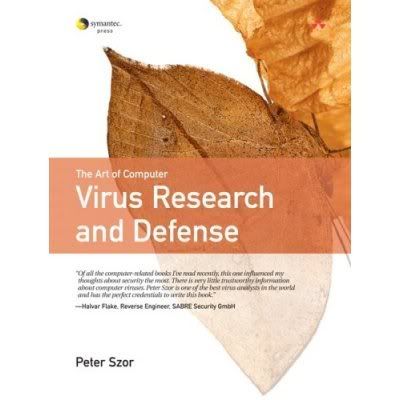
The Art of Computer Virus Research and Defense
Category: Other
Language: English
FileType: CHM
File size: 13773 KB
Preface Preface Who Should Read This Book Over the last two decades, several publications appeared on the subject of computer viruses, but only a few have been written by professionals ("insiders") of computer virus research.
Although many books exist that discuss the computer virus problem, they usually target a novice audience and are simply not too interesting for the technical professionals.
There are only a few works that have no worries going into the technical details, necessary to understand, to effectively defend against computer viruses.
Part of the problem is that existing books have little if any information about the current complexity of computer viruses.
For example, they lack serious technical information on fast-spreading computer worms that exploit vulnerabilities to invade target systems, or they do not discuss recent code evolution techniques such as code metamorphism.
If you wanted to get all the information I have in this book, you would need to spend a lot of time reading articles and papers that are often hidden somewhere deep inside computer virus and security conference proceedings, and perhaps you would need to dig into malicious code for years to extract the relevant details.
I believe that this book is most useful for IT and security professionals who fight against computer viruses on a daily basis.
Nowadays, system administrators as well as individual home users often need to deal with computer worms and other malicious programs on their networks. Unfortunately, security courses have very little training on computer virus protection, and the general public knows very little about how to analyze and defend their network from such attacks.
To make things more difficult, computer virus analysis techniques have not been discussed in any existing works in sufficient length before.
I also think that, for anybody interested in information security, being aware of what the computer virus writers have "achieved" so far is an important thing to know.
For years, computer virus researchers used to be "file" or "infected object" oriented.
To the contrary, security professionals were excited about suspicious events only on the network level.
In addition, threats such as CodeRed worm appeared to inject their code into the memory of vulnerable processes over the network, but did not "infect" objects on the disk.
Today, it is important to understand all of these major perspectives the file (storage), in-memory, and network views and correlate the events using malicious code analysis techniques.
During the years, I have trained many computer virus and security analysts to effectively analyze and respond to malicious code threats.
In this book, I have included information about anything that I ever had to deal with.
For example, I have relevant examples of ancient threats, such as 8-bit viruses on the Commodore 64.
You will see that techniques such as stealth technology appeared in the earliest computer viruses, and on a variety of platforms.
Thus, you will be able to realize that current rootkits do not represent anything new! You will find sufficient coverage on 32-bit Windows worm threats with in-depth exploit discussions, as well as 64-bit viruses and "pocket monsters" on mobile devices.
All along the way, my goal is to illustrate how old techniques "reincarnate" in new threats and demonstrate up-to-date attacks with just enough technical details.
I am sure that many of you are interested in joining the fight against malicious code, and perhaps, just like me, some of you will become inventors of defense techniques.
All of you should, however, be aware of the pitfalls and the challenges of this field! That is what this book is all about.
What I Cover The purpose of this book is to demonstrate the current state of the art of computer virus and antivirus developments and to teach you the methodology of computer virus analysis and protection.
I discuss infection techniques of computer viruses from all possible perspectives: file (on storage), in-memory, and network. I classify and tell you all about the dirty little tricks of computer viruses that bad guys developed over the last two decades and tell you what has been done to deal with complexities such as code polymorphism and exploits.
The easiest way to read this book is, well, to read it from chapter to chapter. However, some of the attack chapters have content that can be more relevant after understanding techniques presented in the defense chapters.
If you feel that any of the chapters are not your taste, or are too difficult or lengthy, you can always jump to the next chapter.
I am sure that everybody will find some parts of this book very difficult and other parts very simple, depending on individual experience.
I expect my readers to be familiar with technology and some level of programming.
There are so many things discussed in this book that it is simply impossible to cover everything in sufficient length.
However, you will know exactly what you might need to learn from elsewhere to be absolutely successful against malicious threats.
To help you, I have created an extensive reference list for each chapter that leads you to the necessary background information.
Indeed, this book could easily have been over 1,000 pages. However, as you can tell, I am not Shakespeare. My knowledge of computer viruses is great, not my English.
Most likely, you would have no benefit of my work if this were the other way around.
What I Do Not Cover I do not cover Trojan horse programs or backdoors in great length.
This book is primarily about self-replicating malicious code. There are plenty of great books available on regular malicious programs, but not on computer viruses.
I do not present any virus code in the book that you could directly use to build another virus.
This book is not a "virus writing" class. My understanding, however, is that the bad guys already know about most of the techniques that I discuss in this book.
So, the good guys need to learn more and start to think (but not act) like a real attacker to develop their defense! Interestingly, many universities attempt to teach computer virus research courses by offering classes on writing viruses.
Would it really help if a student could write a virus to infect millions of systems around the world? Will such students know more about how to develop defense better? Simply, the answer is no...
Instead, classes should focus on the analysis of existing malicious threats. There are so many threats out there waiting for somebody to understand them and do something against them. Of course, the knowledge of computer viruses is like the "Force" in Star Wars .
Depending on the user of the "Force," the knowledge can turn to good or evil. I cannot force you to stay away from the "Dark Side," but I urge you to do so. /> class="navigation"> Copyright Pearson Education. All rights reserved.
Link Download:
http://rapidshare.com/files/68698066/The_Art_Of_Computer_Virus_Research_And_Defense.rar
Password default : shytex.com
Category: Other
Language: English
FileType: CHM
File size: 13773 KB
Preface Preface Who Should Read This Book Over the last two decades, several publications appeared on the subject of computer viruses, but only a few have been written by professionals ("insiders") of computer virus research.
Although many books exist that discuss the computer virus problem, they usually target a novice audience and are simply not too interesting for the technical professionals.
There are only a few works that have no worries going into the technical details, necessary to understand, to effectively defend against computer viruses.
Part of the problem is that existing books have little if any information about the current complexity of computer viruses.
For example, they lack serious technical information on fast-spreading computer worms that exploit vulnerabilities to invade target systems, or they do not discuss recent code evolution techniques such as code metamorphism.
If you wanted to get all the information I have in this book, you would need to spend a lot of time reading articles and papers that are often hidden somewhere deep inside computer virus and security conference proceedings, and perhaps you would need to dig into malicious code for years to extract the relevant details.
I believe that this book is most useful for IT and security professionals who fight against computer viruses on a daily basis.
Nowadays, system administrators as well as individual home users often need to deal with computer worms and other malicious programs on their networks. Unfortunately, security courses have very little training on computer virus protection, and the general public knows very little about how to analyze and defend their network from such attacks.
To make things more difficult, computer virus analysis techniques have not been discussed in any existing works in sufficient length before.
I also think that, for anybody interested in information security, being aware of what the computer virus writers have "achieved" so far is an important thing to know.
For years, computer virus researchers used to be "file" or "infected object" oriented.
To the contrary, security professionals were excited about suspicious events only on the network level.
In addition, threats such as CodeRed worm appeared to inject their code into the memory of vulnerable processes over the network, but did not "infect" objects on the disk.
Today, it is important to understand all of these major perspectives the file (storage), in-memory, and network views and correlate the events using malicious code analysis techniques.
During the years, I have trained many computer virus and security analysts to effectively analyze and respond to malicious code threats.
In this book, I have included information about anything that I ever had to deal with.
For example, I have relevant examples of ancient threats, such as 8-bit viruses on the Commodore 64.
You will see that techniques such as stealth technology appeared in the earliest computer viruses, and on a variety of platforms.
Thus, you will be able to realize that current rootkits do not represent anything new! You will find sufficient coverage on 32-bit Windows worm threats with in-depth exploit discussions, as well as 64-bit viruses and "pocket monsters" on mobile devices.
All along the way, my goal is to illustrate how old techniques "reincarnate" in new threats and demonstrate up-to-date attacks with just enough technical details.
I am sure that many of you are interested in joining the fight against malicious code, and perhaps, just like me, some of you will become inventors of defense techniques.
All of you should, however, be aware of the pitfalls and the challenges of this field! That is what this book is all about.
What I Cover The purpose of this book is to demonstrate the current state of the art of computer virus and antivirus developments and to teach you the methodology of computer virus analysis and protection.
I discuss infection techniques of computer viruses from all possible perspectives: file (on storage), in-memory, and network. I classify and tell you all about the dirty little tricks of computer viruses that bad guys developed over the last two decades and tell you what has been done to deal with complexities such as code polymorphism and exploits.
The easiest way to read this book is, well, to read it from chapter to chapter. However, some of the attack chapters have content that can be more relevant after understanding techniques presented in the defense chapters.
If you feel that any of the chapters are not your taste, or are too difficult or lengthy, you can always jump to the next chapter.
I am sure that everybody will find some parts of this book very difficult and other parts very simple, depending on individual experience.
I expect my readers to be familiar with technology and some level of programming.
There are so many things discussed in this book that it is simply impossible to cover everything in sufficient length.
However, you will know exactly what you might need to learn from elsewhere to be absolutely successful against malicious threats.
To help you, I have created an extensive reference list for each chapter that leads you to the necessary background information.
Indeed, this book could easily have been over 1,000 pages. However, as you can tell, I am not Shakespeare. My knowledge of computer viruses is great, not my English.
Most likely, you would have no benefit of my work if this were the other way around.
What I Do Not Cover I do not cover Trojan horse programs or backdoors in great length.
This book is primarily about self-replicating malicious code. There are plenty of great books available on regular malicious programs, but not on computer viruses.
I do not present any virus code in the book that you could directly use to build another virus.
This book is not a "virus writing" class. My understanding, however, is that the bad guys already know about most of the techniques that I discuss in this book.
So, the good guys need to learn more and start to think (but not act) like a real attacker to develop their defense! Interestingly, many universities attempt to teach computer virus research courses by offering classes on writing viruses.
Would it really help if a student could write a virus to infect millions of systems around the world? Will such students know more about how to develop defense better? Simply, the answer is no...
Instead, classes should focus on the analysis of existing malicious threats. There are so many threats out there waiting for somebody to understand them and do something against them. Of course, the knowledge of computer viruses is like the "Force" in Star Wars .
Depending on the user of the "Force," the knowledge can turn to good or evil. I cannot force you to stay away from the "Dark Side," but I urge you to do so. /> class="navigation"> Copyright Pearson Education. All rights reserved.
Link Download:
http://rapidshare.com/files/68698066/The_Art_Of_Computer_Virus_Research_And_Defense.rar
Password default : shytex.com
.NET Security and Cryptography
Peter Thorsteinson, G. Gnana Arun Ganesh
.NET Security and Cryptography
Prentice Hall PTR - ISBN: 013100851X - Year 2003 - 496 pages - CHM - 3.1 MB
Learn how to make your .NET applications secure!
Security and cryptography, while always an essential part of the computing industry, have seen their importance increase greatly in the last several years. Microsoft's .NET Framework provides developers with a powerful new set of tools to make their applications secure. NET Security and Cryptography is a practical and comprehensive guide to implementing both the security and the cryptography features found in the .NET platform. The authors provide numerous clear and focused examples in both C# and Visual Basic .NET, as well as detailed commentary on how the code works. They cover topics in a logical sequence and context, where they are most relevant and most easily understood.
This book will allow developers to:
Develop a solid basis in the theory of cryptography, so they can understand how the security tools in the .NET Framework function
Learn to use symmetric algorithms, asymmetric algorithms, and digital signatures
Master both traditional encryption programming as well as the new techniques of XML encryption and XML signatures
Learn how these tools apply to ASP.NET and Web Services security
download:
Code:
Password default : shytex.com
Peter Thorsteinson, G. Gnana Arun Ganesh
.NET Security and Cryptography
Prentice Hall PTR - ISBN: 013100851X - Year 2003 - 496 pages - CHM - 3.1 MB
Learn how to make your .NET applications secure!
Security and cryptography, while always an essential part of the computing industry, have seen their importance increase greatly in the last several years. Microsoft's .NET Framework provides developers with a powerful new set of tools to make their applications secure. NET Security and Cryptography is a practical and comprehensive guide to implementing both the security and the cryptography features found in the .NET platform. The authors provide numerous clear and focused examples in both C# and Visual Basic .NET, as well as detailed commentary on how the code works. They cover topics in a logical sequence and context, where they are most relevant and most easily understood.
This book will allow developers to:
Develop a solid basis in the theory of cryptography, so they can understand how the security tools in the .NET Framework function
Learn to use symmetric algorithms, asymmetric algorithms, and digital signatures
Master both traditional encryption programming as well as the new techniques of XML encryption and XML signatures
Learn how these tools apply to ASP.NET and Web Services security
download:
Code:
Password default : shytex.com
Practical Hacking Techniques and Countermeasures
# Provides detailed examples of attacks on Windows and Linux
# Contains numerous screenshots for easily verified results
# Details Linux script compilation and use
# Lists the complete syntax for tools used throughout the book
Examining computer security from the hacker's perspective, Practical Hacking Techniques and Countermeasures employs virtual computers to illustrate how an attack is executed, including the script, compilation, and results. It provides detailed screen shots in each lab for the reader to follow along in a step-by-step process in order to duplicate and understand how the attack works. It enables experimenting with hacking techniques without fear of corrupting computers or violating any laws.
Written in a lab manual style, the book begins with the installation of the VMware� Workstation product and guides the users through detailed hacking labs enabling them to experience what a hacker actually does during an attack. It covers social engineering techniques, footprinting techniques, and scanning tools. Later chapters examine spoofing techniques, sniffing techniques, password cracking, and attack tools. Identifying wireless attacks, the book also explores Trojans, Man-in-the-Middle (MTM) attacks, and Denial of Service (DoS) attacks.
Learn how to secure your computers with this comprehensive guide on hacking techniques and countermeasures
By understanding how an attack occurs the reader can better understand how to defend against it. This book shows how an attack is conceptualized, formulated, and performed. It offers valuable information for constructing a system to defend against attacks and provides a better understanding of securing your own computer or corporate network.
# 752 pages PDF Format
# Publisher: AUERBACH; Har/Cdr edition (November 2, 2006)
# Language: English
# ISBN-10: 0849370574
# ISBN-13: 978-0849370571
http://rapidshare.com/files/98013521/b-559b01.zip.html
Password default : shytex.com
Handbook of Research on Wireless Security, Information Science Reference
Security is one of the most significant components in wireless systems to ensure the integrity of communications among terminals, networks, and services. As the field of wireless communications expands and inundates personal and professional lives worldwide, up-to-date wireless security research and knowledge becomes increasingly more vital to society.
The Handbook of Research on Wireless Security combines research from esteemed experts on security issues in various wireless communications, recent advances in wireless security, the wireless security model, and future directions in wireless security. As an innovative and current reference source for students, educators, faculty members, researchers, engineers in the field of wireless security, this handbook will make an invaluable addition to any library collection.
URL :
Code:
http://www.amazon.com/exec/obidos/tg/detail/-/159904899X/
DOWNLOAD :
Code:
http://rapidshare.com/files/112187178/IGI.Global.Handbook.of.Research.on.Wireless.Security.Mar.2008.pdf
Password default : shytex.com
The Database Hacker�s Handbook: Defending Database Servers
Databases are the nerve center of our economy. Every piece of your personal information is stored there�medical records, bank accounts, employment history, pensions, car registrations, even your children�s grades and what groceries you buy. Database attacks are potentially crippling�and relentless.
In this essential follow-up to The Shellcoder�s Handbook, four of the world�s top security experts teach you to break into and defend the seven most popular database servers. You�ll learn how to identify vulnerabilities, how attacks are carried out, and how to stop the carnage. The bad guys already know all this. You need to know it too.
- Identify and plug the new holes in Oracle and Microsoft SQL Server
- Learn the best defenses for IBM�s DB2, PostgreSQL, Sybase ASE, and MySQL servers
- Discover how buffer overflow exploitation, privilege escalation through SQL, stored procedure or trigger abuse, and SQL injection enable hacker access
- Recognize vulnerabilities peculiar to each database
- Find out what the attackers already know
Link Arrow
http://rapidshare.com/files/2226538/The_DBH_Handbook.rar.html
Password default : shytex.com
LAN Switch Security: What Hackers Know About Your Switches
Eric Vyncke, Christopher Paggen, "LAN Switch Security: What Hackers Know About Your Switches"
Cisco Press | ISBN:1587052563 | September 6, 2007 | 360 pages | CHM | 2.7MB
Contrary to popular belief, Ethernet switches are not inherently secure. Security vulnerabilities in Ethernet switches are multiple: from the switch implementation, to control plane protocols (Spanning Tree Protocol [STP], Cisco� Discovery Protocol [CDP], and so on) and data plane protocols, such as Address Routing Protocol (ARP) or Dynamic Host Configuration Protocol (DHCP). LAN Switch Security explains all the vulnerabilities in a network infrastructure related to Ethernet switches. Further, this book shows you how to configure a switch to prevent or to mitigate attacks based on those vulnerabilities. This book also includes a section on how to use an Ethernet switch to increase the security of a network and prevent future attacks.
Download:
http://rapidshare.com/files/51519321/1587052563.zip
Password default : shytex.com
Hacking - The Art of Exploitation
This text introduces the spirit and theory of hacking as well as the science behind it all; it also provides some core techniques and tricks of hacking so you can think like a hacker, write your own hacks or thwart potential system attacks.
Link Download:
Code:
http://rapidshare.com/files/27159770/Hacking-The_Art_of_Exploitation.rar
Password default : shytex.com
The Art of Computer Virus Research and Defense
Category: Other
Language: English
FileType: CHM
File size: 13773 KB
Preface Preface Who Should Read This Book Over the last two decades, several publications appeared on the subject of computer viruses, but only a few have been written by professionals ("insiders") of computer virus research.
Although many books exist that discuss the computer virus problem, they usually target a novice audience and are simply not too interesting for the technical professionals.
There are only a few works that have no worries going into the technical details, necessary to understand, to effectively defend against computer viruses.
Part of the problem is that existing books have little if any information about the current complexity of computer viruses.
For example, they lack serious technical information on fast-spreading computer worms that exploit vulnerabilities to invade target systems, or they do not discuss recent code evolution techniques such as code metamorphism.
If you wanted to get all the information I have in this book, you would need to spend a lot of time reading articles and papers that are often hidden somewhere deep inside computer virus and security conference proceedings, and perhaps you would need to dig into malicious code for years to extract the relevant details.
I believe that this book is most useful for IT and security professionals who fight against computer viruses on a daily basis.
Nowadays, system administrators as well as individual home users often need to deal with computer worms and other malicious programs on their networks. Unfortunately, security courses have very little training on computer virus protection, and the general public knows very little about how to analyze and defend their network from such attacks.
To make things more difficult, computer virus analysis techniques have not been discussed in any existing works in sufficient length before.
I also think that, for anybody interested in information security, being aware of what the computer virus writers have "achieved" so far is an important thing to know.
For years, computer virus researchers used to be "file" or "infected object" oriented.
To the contrary, security professionals were excited about suspicious events only on the network level.
In addition, threats such as CodeRed worm appeared to inject their code into the memory of vulnerable processes over the network, but did not "infect" objects on the disk.
Today, it is important to understand all of these major perspectives the file (storage), in-memory, and network views and correlate the events using malicious code analysis techniques.
During the years, I have trained many computer virus and security analysts to effectively analyze and respond to malicious code threats.
In this book, I have included information about anything that I ever had to deal with.
For example, I have relevant examples of ancient threats, such as 8-bit viruses on the Commodore 64.
You will see that techniques such as stealth technology appeared in the earliest computer viruses, and on a variety of platforms.
Thus, you will be able to realize that current rootkits do not represent anything new! You will find sufficient coverage on 32-bit Windows worm threats with in-depth exploit discussions, as well as 64-bit viruses and "pocket monsters" on mobile devices.
All along the way, my goal is to illustrate how old techniques "reincarnate" in new threats and demonstrate up-to-date attacks with just enough technical details.
I am sure that many of you are interested in joining the fight against malicious code, and perhaps, just like me, some of you will become inventors of defense techniques.
All of you should, however, be aware of the pitfalls and the challenges of this field! That is what this book is all about.
What I Cover The purpose of this book is to demonstrate the current state of the art of computer virus and antivirus developments and to teach you the methodology of computer virus analysis and protection.
I discuss infection techniques of computer viruses from all possible perspectives: file (on storage), in-memory, and network. I classify and tell you all about the dirty little tricks of computer viruses that bad guys developed over the last two decades and tell you what has been done to deal with complexities such as code polymorphism and exploits.
The easiest way to read this book is, well, to read it from chapter to chapter. However, some of the attack chapters have content that can be more relevant after understanding techniques presented in the defense chapters.
If you feel that any of the chapters are not your taste, or are too difficult or lengthy, you can always jump to the next chapter.
I am sure that everybody will find some parts of this book very difficult and other parts very simple, depending on individual experience.
I expect my readers to be familiar with technology and some level of programming.
There are so many things discussed in this book that it is simply impossible to cover everything in sufficient length.
However, you will know exactly what you might need to learn from elsewhere to be absolutely successful against malicious threats.
To help you, I have created an extensive reference list for each chapter that leads you to the necessary background information.
Indeed, this book could easily have been over 1,000 pages. However, as you can tell, I am not Shakespeare. My knowledge of computer viruses is great, not my English.
Most likely, you would have no benefit of my work if this were the other way around.
What I Do Not Cover I do not cover Trojan horse programs or backdoors in great length.
This book is primarily about self-replicating malicious code. There are plenty of great books available on regular malicious programs, but not on computer viruses.
I do not present any virus code in the book that you could directly use to build another virus.
This book is not a "virus writing" class. My understanding, however, is that the bad guys already know about most of the techniques that I discuss in this book.
So, the good guys need to learn more and start to think (but not act) like a real attacker to develop their defense! Interestingly, many universities attempt to teach computer virus research courses by offering classes on writing viruses.
Would it really help if a student could write a virus to infect millions of systems around the world? Will such students know more about how to develop defense better? Simply, the answer is no...
Instead, classes should focus on the analysis of existing malicious threats. There are so many threats out there waiting for somebody to understand them and do something against them. Of course, the knowledge of computer viruses is like the "Force" in Star Wars .
Depending on the user of the "Force," the knowledge can turn to good or evil. I cannot force you to stay away from the "Dark Side," but I urge you to do so. /> class="navigation"> Copyright Pearson Education. All rights reserved.
Link Download:
http://rapidshare.com/files/68698066/The_Art_Of_Computer_Virus_Research_And_Defense.rar
Password default : shytex.com
Category: Other
Language: English
FileType: CHM
File size: 13773 KB
Preface Preface Who Should Read This Book Over the last two decades, several publications appeared on the subject of computer viruses, but only a few have been written by professionals ("insiders") of computer virus research.
Although many books exist that discuss the computer virus problem, they usually target a novice audience and are simply not too interesting for the technical professionals.
There are only a few works that have no worries going into the technical details, necessary to understand, to effectively defend against computer viruses.
Part of the problem is that existing books have little if any information about the current complexity of computer viruses.
For example, they lack serious technical information on fast-spreading computer worms that exploit vulnerabilities to invade target systems, or they do not discuss recent code evolution techniques such as code metamorphism.
If you wanted to get all the information I have in this book, you would need to spend a lot of time reading articles and papers that are often hidden somewhere deep inside computer virus and security conference proceedings, and perhaps you would need to dig into malicious code for years to extract the relevant details.
I believe that this book is most useful for IT and security professionals who fight against computer viruses on a daily basis.
Nowadays, system administrators as well as individual home users often need to deal with computer worms and other malicious programs on their networks. Unfortunately, security courses have very little training on computer virus protection, and the general public knows very little about how to analyze and defend their network from such attacks.
To make things more difficult, computer virus analysis techniques have not been discussed in any existing works in sufficient length before.
I also think that, for anybody interested in information security, being aware of what the computer virus writers have "achieved" so far is an important thing to know.
For years, computer virus researchers used to be "file" or "infected object" oriented.
To the contrary, security professionals were excited about suspicious events only on the network level.
In addition, threats such as CodeRed worm appeared to inject their code into the memory of vulnerable processes over the network, but did not "infect" objects on the disk.
Today, it is important to understand all of these major perspectives the file (storage), in-memory, and network views and correlate the events using malicious code analysis techniques.
During the years, I have trained many computer virus and security analysts to effectively analyze and respond to malicious code threats.
In this book, I have included information about anything that I ever had to deal with.
For example, I have relevant examples of ancient threats, such as 8-bit viruses on the Commodore 64.
You will see that techniques such as stealth technology appeared in the earliest computer viruses, and on a variety of platforms.
Thus, you will be able to realize that current rootkits do not represent anything new! You will find sufficient coverage on 32-bit Windows worm threats with in-depth exploit discussions, as well as 64-bit viruses and "pocket monsters" on mobile devices.
All along the way, my goal is to illustrate how old techniques "reincarnate" in new threats and demonstrate up-to-date attacks with just enough technical details.
I am sure that many of you are interested in joining the fight against malicious code, and perhaps, just like me, some of you will become inventors of defense techniques.
All of you should, however, be aware of the pitfalls and the challenges of this field! That is what this book is all about.
What I Cover The purpose of this book is to demonstrate the current state of the art of computer virus and antivirus developments and to teach you the methodology of computer virus analysis and protection.
I discuss infection techniques of computer viruses from all possible perspectives: file (on storage), in-memory, and network. I classify and tell you all about the dirty little tricks of computer viruses that bad guys developed over the last two decades and tell you what has been done to deal with complexities such as code polymorphism and exploits.
The easiest way to read this book is, well, to read it from chapter to chapter. However, some of the attack chapters have content that can be more relevant after understanding techniques presented in the defense chapters.
If you feel that any of the chapters are not your taste, or are too difficult or lengthy, you can always jump to the next chapter.
I am sure that everybody will find some parts of this book very difficult and other parts very simple, depending on individual experience.
I expect my readers to be familiar with technology and some level of programming.
There are so many things discussed in this book that it is simply impossible to cover everything in sufficient length.
However, you will know exactly what you might need to learn from elsewhere to be absolutely successful against malicious threats.
To help you, I have created an extensive reference list for each chapter that leads you to the necessary background information.
Indeed, this book could easily have been over 1,000 pages. However, as you can tell, I am not Shakespeare. My knowledge of computer viruses is great, not my English.
Most likely, you would have no benefit of my work if this were the other way around.
What I Do Not Cover I do not cover Trojan horse programs or backdoors in great length.
This book is primarily about self-replicating malicious code. There are plenty of great books available on regular malicious programs, but not on computer viruses.
I do not present any virus code in the book that you could directly use to build another virus.
This book is not a "virus writing" class. My understanding, however, is that the bad guys already know about most of the techniques that I discuss in this book.
So, the good guys need to learn more and start to think (but not act) like a real attacker to develop their defense! Interestingly, many universities attempt to teach computer virus research courses by offering classes on writing viruses.
Would it really help if a student could write a virus to infect millions of systems around the world? Will such students know more about how to develop defense better? Simply, the answer is no...
Instead, classes should focus on the analysis of existing malicious threats. There are so many threats out there waiting for somebody to understand them and do something against them. Of course, the knowledge of computer viruses is like the "Force" in Star Wars .
Depending on the user of the "Force," the knowledge can turn to good or evil. I cannot force you to stay away from the "Dark Side," but I urge you to do so. /> class="navigation"> Copyright Pearson Education. All rights reserved.
Link Download:
http://rapidshare.com/files/68698066/The_Art_Of_Computer_Virus_Research_And_Defense.rar
Password default : shytex.com
Gray Hat Hacking, Second Edition (Paperback)
Prevent catastrophic network attacks by exposing security flaws, fixing
them, and ethically reporting them to the software author. Fully
expanded to cover the hacker's latest devious methods, Gray Hat Hacking:
The Ethical Hacker's Handbook, Second Edition lays out each exploit
alongside line-by-line code samples, detailed countermeasures, and moral
disclosure procedures. Find out how to execute effective penetration
tests, use fuzzers and sniffers, perform reverse engineering, and find
security holes in Windows and Linux applications. You'll also learn how
to trap and autopsy stealth worms, viruses, rootkits, adware, and
malware.
- Implement vulnerability testing, discovery, and reporting procedures
that comply with applicable laws
- Learn the basics of programming, stack operations, buffer overflow
and heap vulnerabilities, and exploit development
- Test and exploit systems using Metasploit and other tools
- Break in to Windows and Linux systems with perl scripts, Python
scripts, and customized C programs
- Analyze source code using ITS4, RATS, FlawFinder, PREfast, Splint,
and decompilers
- Understand the role of IDA Pro scripts, FLAIR tools, and third-party
plug-ins in discovering software vulnerabilities
- Reverse-engineer software using decompiling, profiling, memory
monitoring, and data flow analysis tools
- Reveal client-side web browser vulnerabilities with MangleMe, AxEnum,
and AxMan
- Probe Windows Access Controls to discover insecure access tokens,
security descriptors, DACLs, and ACEs
- Find and examine malware and rootkits using honeypots, honeynets, and
Norman SandBox technology
URL:
Code:
http://www.amazon.com/exec/obidos/tg/detail/-/0071495681/
Download:
Code:
http://rapidshare.com/files/95223553/McGraw.Hill.Gray.Hat.Hacking.2nd.Edition.Dec.2007.pdf
Password default : shytex.com
Gray Hat Hacking, Second Edition (Paperback)
Prevent catastrophic network attacks by exposing security flaws, fixing
them, and ethically reporting them to the software author. Fully
expanded to cover the hacker's latest devious methods, Gray Hat Hacking:
The Ethical Hacker's Handbook, Second Edition lays out each exploit
alongside line-by-line code samples, detailed countermeasures, and moral
disclosure procedures. Find out how to execute effective penetration
tests, use fuzzers and sniffers, perform reverse engineering, and find
security holes in Windows and Linux applications. You'll also learn how
to trap and autopsy stealth worms, viruses, rootkits, adware, and
malware.
- Implement vulnerability testing, discovery, and reporting procedures
that comply with applicable laws
- Learn the basics of programming, stack operations, buffer overflow
and heap vulnerabilities, and exploit development
- Test and exploit systems using Metasploit and other tools
- Break in to Windows and Linux systems with perl scripts, Python
scripts, and customized C programs
- Analyze source code using ITS4, RATS, FlawFinder, PREfast, Splint,
and decompilers
- Understand the role of IDA Pro scripts, FLAIR tools, and third-party
plug-ins in discovering software vulnerabilities
- Reverse-engineer software using decompiling, profiling, memory
monitoring, and data flow analysis tools
- Reveal client-side web browser vulnerabilities with MangleMe, AxEnum,
and AxMan
- Probe Windows Access Controls to discover insecure access tokens,
security descriptors, DACLs, and ACEs
- Find and examine malware and rootkits using honeypots, honeynets, and
Norman SandBox technology
URL:
Code:
http://www.amazon.com/exec/obidos/tg/detail/-/0071495681/
Download:
Code:
http://rapidshare.com/files/95223553/McGraw.Hill.Gray.Hat.Hacking.2nd.Edition.Dec.2007.pdf
Password default : shytex.com
Hacking Exposed Web 2.0: Web 2.0 Security Secrets and Solutions
"This book concisely identifies the types of attacks which are faced
daily by Web 2.0 sites, and the authors give solid, practical advice on
how to identify and mitigate these threats." --Max Kelly, CISSP, CIPP,
CFCE, Senior Director of Security, Facebook Protect your Web 2.0
architecture against the latest wave of cybercrime using expert tactics
from Internet security professionals. Hacking Exposed Web 2.0 shows how
hackers perform reconnaissance, choose their entry point, and attack Web
2.0-based services, and reveals detailed countermeasures and defense
techniques. You'll learn how to avoid injection and buffer overflow
attacks, fix browser and plug-in flaws, and secure AJAX, Flash, and
XML-driven applications. Real-world case studies illustrate social
networking site weaknesses, cross-site attack methods, migration
vulnerabilities, and IE7 shortcomings.
- Plug security holes in Web 2.0 implementations the proven Hacking
Exposed way
- Learn how hackers target and abuse vulnerable Web 2.0 applications,
browsers, plug-ins, online databases, user inputs, and HTML forms
- Prevent Web 2.0-based SQL, XPath, XQuery, LDAP, and command
injection attacks
- Circumvent XXE, directory traversal, and buffer overflow exploits
- Learn XSS and Cross-Site Request Forgery methods attackers use to
bypass browser security controls
- Fix vulnerabilities in Outlook Express and Acrobat Reader add-ons
- Use input validators and XML classes to reinforce ASP and .NET
security
- Eliminate unintentional exposures in ASP.NET AJAX (Atlas), Direct
Web Remoting, Sajax, and GWT Web applications
- Mitigate ActiveX security exposures using SiteLock, code signing,
and secure controls
- Find and fix Adobe Flash vulnerabilities and DNS rebinding attacks
URL:
Code:
http://www.amazon.com/exec/obidos/tg/detail/-/0071494618/
Code:
http://rapidshare.com/files/95219435/McGraw.Hill.Hacking.Exposed.Web.2.0.Dec.2007.pdf
Password default : shytex.com
Hacking Exposed Web 2.0: Web 2.0 Security Secrets and Solutions
"This book concisely identifies the types of attacks which are faced
daily by Web 2.0 sites, and the authors give solid, practical advice on
how to identify and mitigate these threats." --Max Kelly, CISSP, CIPP,
CFCE, Senior Director of Security, Facebook Protect your Web 2.0
architecture against the latest wave of cybercrime using expert tactics
from Internet security professionals. Hacking Exposed Web 2.0 shows how
hackers perform reconnaissance, choose their entry point, and attack Web
2.0-based services, and reveals detailed countermeasures and defense
techniques. You'll learn how to avoid injection and buffer overflow
attacks, fix browser and plug-in flaws, and secure AJAX, Flash, and
XML-driven applications. Real-world case studies illustrate social
networking site weaknesses, cross-site attack methods, migration
vulnerabilities, and IE7 shortcomings.
- Plug security holes in Web 2.0 implementations the proven Hacking
Exposed way
- Learn how hackers target and abuse vulnerable Web 2.0 applications,
browsers, plug-ins, online databases, user inputs, and HTML forms
- Prevent Web 2.0-based SQL, XPath, XQuery, LDAP, and command
injection attacks
- Circumvent XXE, directory traversal, and buffer overflow exploits
- Learn XSS and Cross-Site Request Forgery methods attackers use to
bypass browser security controls
- Fix vulnerabilities in Outlook Express and Acrobat Reader add-ons
- Use input validators and XML classes to reinforce ASP and .NET
security
- Eliminate unintentional exposures in ASP.NET AJAX (Atlas), Direct
Web Remoting, Sajax, and GWT Web applications
- Mitigate ActiveX security exposures using SiteLock, code signing,
and secure controls
- Find and fix Adobe Flash vulnerabilities and DNS rebinding attacks
URL:
Code:
http://www.amazon.com/exec/obidos/tg/detail/-/0071494618/
Code:
http://rapidshare.com/files/95219435/McGraw.Hill.Hacking.Exposed.Web.2.0.Dec.2007.pdf
Password default : shytex.com
Tom St Denis, �Cryptography for Developers�
Publisher: Syngress Publishing | English | ISBN: 1597491047 | PDF | 5.01 MB | 400 Pages
Developers tasked with security problems are often not cryptographers themselves. They are bright people who, with careful guidance, can implement secure cryptosystems. This book will guide developers in their journey towards solving cryptographic problems. If you have ever asked yourself "just how do I setup AES?" then this text is for you. ASN.1 Encoding The chapter on ASN.1 encoding delivers a treatment of the Abstract Syntax Notation One (ASN.1) encoding rules for data elements such as strings, binary strings, integers, dates and times, and sets and sequences. Random Number Generation This chapter discusses the design and construction of standard random number generators (RNGs) such as those specified by NIST. Advanced Encryption Standard This chapter discusses the AES block cipher design, implementation trade-offs, side channel hazards, and modes of use. It concentrates on the key design elements important to implementers and how to exploit them in various trade-off conditions. Hash Functions This chapter discusses collision resistance, provides examples of exploits, and concludes with known incorrect usage patterns. Message Authentication Code Algorithms This chapter discusses the HMAC and CMAC Message Authentication Code (MAC) algorithms, which are constructed from hash and cipher functions. Encrypt and Authenticate Modes This chapter discusses the IEEE and NIST encrypt and authenticate modes GCM and CCM. Both modes introduce new concepts to cryptographic functions. Focus is given to the concept of replay attacks, and initialization techniques are explored in depth. Large Integer Arithmetic This chapter discusses the techniques behind manipulating large integers such as those used in public key algorithms. Public Key Algorithms This chapter introduces public key cryptography, including the RSA algorithm and its related PKCS #1 padding schemes. It also introduces new math in the form of various elliptic curve point multipliers.
Link Download:
Code:
http://dl43tl2.rapidshare.com/files/5874805/Cryptography_for_Developers_EBook_ISBN-1597491047.rar
Password default : shytex.com
Hacking Exposed Windows: Microsoft Windows Security Secrets and, Solutions, Third Edition (Hacking Exposed) (Paperback)
Meet the challenges of Windows security with the exclusive Hacking
Exposed "attack-countermeasure" approach. Learn how real-world malicious
hackers conduct reconnaissance of targets and then exploit common
misconfigurations and software flaws on both clients and servers. See
leading-edge exploitation techniques demonstrated, and learn how the
latest countermeasures in Windows XP, Vista, and Server 2003/2008 can
mitigate these attacks. Get practical advice based on the authors' and
contributors' many years as security professionals hired to break into
the world's largest IT infrastructures. Dramatically improve the
security of Microsoft technology deployments of all sizes when you learn
to:
- Establish business relevance and context for security by highlighting
real-world risks
- Take a tour of the Windows security architecture from the hacker's
perspective, exposing old and new vulnerabilities that can easily be
avoided
- Understand how hackers use reconnaissance techniques such as
footprinting, scanning, banner grabbing, DNS queries, and Google
searches to locate vulnerable Windows systems
- Learn how information is extracted anonymously from Windows using
simple NetBIOS, SMB, MSRPC, SNMP, and Active Directory enumeration
techniques
- Prevent the latest remote network exploits such as password grinding
via WMI and Terminal Server, passive Kerberos logon sniffing, rogue
server/man-in-the-middle attacks, and cracking vulnerable services
- See up close how professional hackers reverse engineer and develop
new Windows exploits
- Identify and eliminate rootkits, malware, and stealth software
- Fortify SQL Server against external and insider attacks
- Harden your clients and users against the latest e-mail phishing,
spyware, adware, and Internet Explorer threats
- Deploy and configure the latest Windows security countermeasures,
including BitLocker, Integrity Levels, User Account Control, the updated
Windows Firewall, Group Policy, Vista Service Refactoring/Hardening,
SafeSEH, GS, DEP, Patchguard, and Address Space Layout Randomization
URL:
Code:
http://www.amazon.com/exec/obidos/tg/detail/-/007149426X/
Download:
Code:
http://rapidshare.com/files/93030576/McGraw.Hill.Hacking.Exposed.Windows.3rd.Edition.Dec.2007.pdf
Password default : shytex.com
Hacker Disassembling Uncovered
A-List Publishing | ISBN: 1931769222 | 600 pages | 4.8MB | CHM
Going beyond the issues of analyzing and optimizing programs as well as creating the means of protecting information, this guide takes on the programming problem of, once having found holes in a program, how to go about disassembling it without its source code. Covered are the hacking methods used to analyze programs using a debugger and disassembler. These methods include virtual functions, local and global variables, branching, loops, objects and their hierarchy, and mathematical operators. Also covered are methods of fighting disassemblers, self-modifying code in operating systems, and executing code in the stack. Advanced disassembler topics such as optimizing compilers and movable code are discussed as well.
Link Download:
http://rapidshare.com/files/137499577/A.LIST.Publishing.Hacker.Disassembling.Uncovered.eBook-LiB.chm
Password default : shytex.com
Tom St Denis, �Cryptography for Developers�
Publisher: Syngress Publishing | English | ISBN: 1597491047 | PDF | 5.01 MB | 400 Pages
Developers tasked with security problems are often not cryptographers themselves. They are bright people who, with careful guidance, can implement secure cryptosystems. This book will guide developers in their journey towards solving cryptographic problems. If you have ever asked yourself "just how do I setup AES?" then this text is for you. ASN.1 Encoding The chapter on ASN.1 encoding delivers a treatment of the Abstract Syntax Notation One (ASN.1) encoding rules for data elements such as strings, binary strings, integers, dates and times, and sets and sequences. Random Number Generation This chapter discusses the design and construction of standard random number generators (RNGs) such as those specified by NIST. Advanced Encryption Standard This chapter discusses the AES block cipher design, implementation trade-offs, side channel hazards, and modes of use. It concentrates on the key design elements important to implementers and how to exploit them in various trade-off conditions. Hash Functions This chapter discusses collision resistance, provides examples of exploits, and concludes with known incorrect usage patterns. Message Authentication Code Algorithms This chapter discusses the HMAC and CMAC Message Authentication Code (MAC) algorithms, which are constructed from hash and cipher functions. Encrypt and Authenticate Modes This chapter discusses the IEEE and NIST encrypt and authenticate modes GCM and CCM. Both modes introduce new concepts to cryptographic functions. Focus is given to the concept of replay attacks, and initialization techniques are explored in depth. Large Integer Arithmetic This chapter discusses the techniques behind manipulating large integers such as those used in public key algorithms. Public Key Algorithms This chapter introduces public key cryptography, including the RSA algorithm and its related PKCS #1 padding schemes. It also introduces new math in the form of various elliptic curve point multipliers.
Link Download:
Code:
http://dl43tl2.rapidshare.com/files/5874805/Cryptography_for_Developers_EBook_ISBN-1597491047.rar
Password default : shytex.com
Hacking Exposed Windows: Microsoft Windows Security Secrets and, Solutions, Third Edition (Hacking Exposed) (Paperback)
Meet the challenges of Windows security with the exclusive Hacking
Exposed "attack-countermeasure" approach. Learn how real-world malicious
hackers conduct reconnaissance of targets and then exploit common
misconfigurations and software flaws on both clients and servers. See
leading-edge exploitation techniques demonstrated, and learn how the
latest countermeasures in Windows XP, Vista, and Server 2003/2008 can
mitigate these attacks. Get practical advice based on the authors' and
contributors' many years as security professionals hired to break into
the world's largest IT infrastructures. Dramatically improve the
security of Microsoft technology deployments of all sizes when you learn
to:
- Establish business relevance and context for security by highlighting
real-world risks
- Take a tour of the Windows security architecture from the hacker's
perspective, exposing old and new vulnerabilities that can easily be
avoided
- Understand how hackers use reconnaissance techniques such as
footprinting, scanning, banner grabbing, DNS queries, and Google
searches to locate vulnerable Windows systems
- Learn how information is extracted anonymously from Windows using
simple NetBIOS, SMB, MSRPC, SNMP, and Active Directory enumeration
techniques
- Prevent the latest remote network exploits such as password grinding
via WMI and Terminal Server, passive Kerberos logon sniffing, rogue
server/man-in-the-middle attacks, and cracking vulnerable services
- See up close how professional hackers reverse engineer and develop
new Windows exploits
- Identify and eliminate rootkits, malware, and stealth software
- Fortify SQL Server against external and insider attacks
- Harden your clients and users against the latest e-mail phishing,
spyware, adware, and Internet Explorer threats
- Deploy and configure the latest Windows security countermeasures,
including BitLocker, Integrity Levels, User Account Control, the updated
Windows Firewall, Group Policy, Vista Service Refactoring/Hardening,
SafeSEH, GS, DEP, Patchguard, and Address Space Layout Randomization
URL:
Code:
http://www.amazon.com/exec/obidos/tg/detail/-/007149426X/
Download:
Code:
http://rapidshare.com/files/93030576/McGraw.Hill.Hacking.Exposed.Windows.3rd.Edition.Dec.2007.pdf
Password default : shytex.com
Hacker Disassembling Uncovered
A-List Publishing | ISBN: 1931769222 | 600 pages | 4.8MB | CHM
Going beyond the issues of analyzing and optimizing programs as well as creating the means of protecting information, this guide takes on the programming problem of, once having found holes in a program, how to go about disassembling it without its source code. Covered are the hacking methods used to analyze programs using a debugger and disassembler. These methods include virtual functions, local and global variables, branching, loops, objects and their hierarchy, and mathematical operators. Also covered are methods of fighting disassemblers, self-modifying code in operating systems, and executing code in the stack. Advanced disassembler topics such as optimizing compilers and movable code are discussed as well.
Link Download:
http://rapidshare.com/files/137499577/A.LIST.Publishing.Hacker.Disassembling.Uncovered.eBook-LiB.chm
Password default : shytex.com
Subscribe to:
Comments (Atom)
This site does not store any files on its server.We only index and link to content provided by other sites. In case of any query/objection regarding copyright or piracy, please inform us at youzhny197@gmail.com, we will immediately respond to you.
http://rapidshare.com/files/116430857/Hackers.Challenge.pdf